

Today, Anthropic and OpenAI are charging consumers a $20 per month subscription when they charge businesses API prices, which sometimes mean paying more than $1,000 per month for the same value. When you charge one customer $20 and charge the very same customer $1,000 for the same value, it means you are either ripping off one side of subsidize heavily the other. Regardless, it is not economically sustainable.
The problem is expanding beyond AI providers: any company building an AI product has no idea how to price AI feature. For example, GitHub introduced the concept of “AI credits” where consumers pay (on top of their existing seat) for the tokens they use. The more token you use, the more you pay. But this model is non-sensical and reveals the fundamental flaw everybody falls into. Existing product prices do not depend on the amount of CPU or RAM it uses. Similarly, we should not bill a customer for the amount of GPU (e.g. tokens) used. But nobody know how to price AI products, and the industry decided to bill the amount of tokens used.
This is a trap: a billing model should be based on the value of the outcome, not on the implementation detail. The user does not care that a product is using GPT-5.6, Opus or Kimi. The user cares about the outcome, regardless of the implementation.
Anatomy of an AI Application
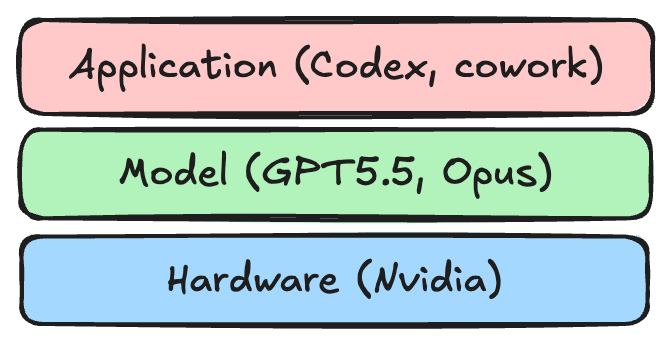
An AI-enabled application is composed of three layers:
Hardware (blue on the picture below). there are very few players in the space: Nvidia or Google (with their TPUs) are the most famous and used in the US (Tesla also has its custom chip). The cost of entry is enormous and it takes years to enter this market.
Model (green on the picture below): this is the model that gives an answer based on some inputs and some tools. Frontier labs are known for GPT-5.5, Opus and open-source models are available with Deepseek or Kimi.
Application (red on the picture below): this is what many software companies (e.g. Facebook, Salesforce) are building. At the application layer, it’s aggregating data and context that is later sent to a model and hopefully provide some value to the end-user.
If you compare this to existing application, the model is the equivalent of what the operating system and libraries/frameworks provide. The hardware was CPU, now, it’s GPU. Note that in the early days of the internet, there was some hardware lock-ins (who remembers Sun Microsystems and they Sparc CPU architecture and their Solaris Operating System?) but this did not last long.
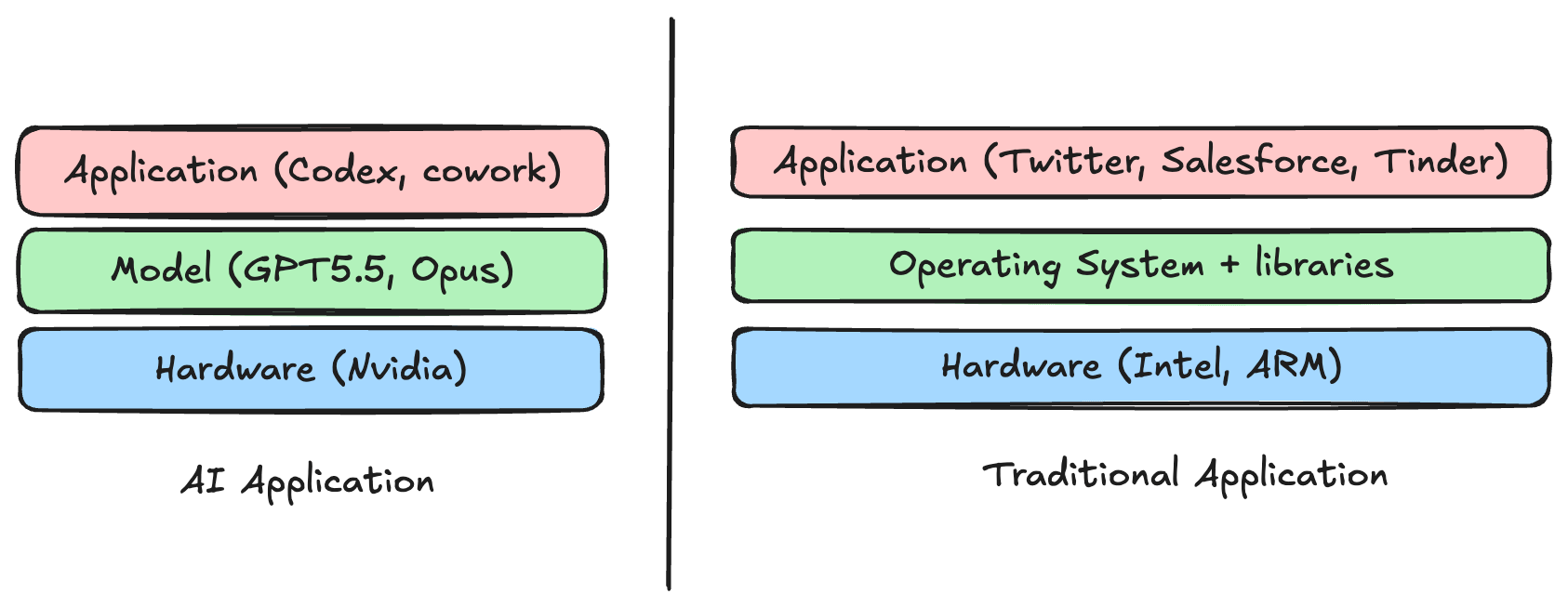
Note that only the application layer is visible to the end-user. The hardware or software does not matter at all to the end-user - this is an implementation details: as long as the user has a value, these details are irrelevant.
What frontier labs are selling you?
Today, frontier labs are selling you a model (green on the figure above) and some GPU time (blue on the model above).
Each time you make a request to OpenAI or Anthropic, they need to pay for the GPU time spent to serve this request (the blue part in the model). This means building giant datacenters, buying thousands of Nvidia GPUs and paying electricity.
On top of this, they need to pay for the development of their models (the green part), which means getting the data, building the training data set, building evals.
To make it simple, when you pay $10 for a few million tokens, some money goes to pay the GPUs used to serve your request (blue) and some money go towards developing new models or pay back the development cost of the model you use (green).
Frontier labs realized very quickly that this business model is very limited and not sustainable:
any other company will eventually build a new model and replace them. Or even worse: open-source models can completely replace them and users just need to pay the GPUs via their existing cloud providers.
the real value does not live in the model but in the application layer. In fact, the model layer will be commoditized, the very same way the operating system or the webserver was commoditized.
They quickly realized that the real value is not in the model itself (the blue or green) but in the application layer (the red part). After all, an AI application for a lawyer or software engineer will extract more dollar value than an AI-enabled dating application. That’s why Anthropic got into the Claude Code bandwagon and is releasing new products every other week - they are trying to capture the real value of AI. They no longer want to sell you token but sell you an outcome.
Frontier labs need to capture value to stay relevant
Once Frontier labs realized they need to capture the application-layer (red in the diagram above), they started to release new applications to see what stick with the user. New products are coming regularly: Claude Code, Claude CoWork, Claude Legal, Claude Design - the goal is to capture the AI-enabled space for every domain before someone else does. And traditional software companies (Salesforce, Microsoft) also keep releasing new features with a similar pricing model (e.g. pay by token usage).
However, the cost does not match the value. For example, a lawyer using ChatGPT or Claude can easily justify a high price, higher than a simple chat application. An agentic application that automates your work (e.g. summarizes your customer calls, manager your agenda) provides more value than a summary of a Word document. But both are still billed using the same method (tokens).
This is where it’s hard to see the value of AI and harder to justify AI budgets. After all, software companies spent millions of dollars on tokens and do not see a comparable increase of productivity. AI made me more productive but it did not increase my productivity by 10, it rather increases productivity by 10% to 30% at best.
The typical counter-argument says that GPU and inference cost (green and blue part of the diagram) will go down. However, if these prices go down, it means that billing per token will be irrelevant and the pricing model needs to change as well. It also means that traditional software companies can use open-source models, integrate AI features at a marginal cost and make frontier models irrelevant.
The future of AI application pricing
I believe that AI (call them AI-native, AI-enabled or agentic) applications pricing will change dramatically in the next 18 months.
open-source models will get more traction, match frontier models performance for most use-case and make them irrelevant
inference prices will go down thanks to software optimization and more performant hardware
The AI winner will not be the current model providers. It will be the existing applications that have enough data to feed context to the model. These companies will integrate open-source models into their application. Once they define the real value of the application, they will change their pricing based in the product value and customer outcome.